From the perspective of Jineoloji – The Women’s Library in Suleymaniye
by Gisela Rhein, Librarian (This article was first published in German by https://kurdistan-report.de/kurdistan-report-nr-238/)
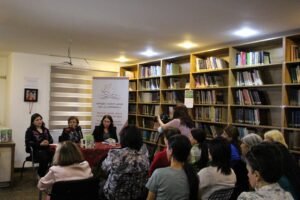
Women need a space of their own to write, think, and share their feelings and stories. Virginia Wolf articulated this demand in her book “A Room of One’s Own” as early as 1929.
Şehid Zilan was also impressed by this book and, many years later, implemented this idea, symbolically laying the foundation for a space open to all women. In Suleymaniyah in Bașur (Southern Kurdistan) in northern Iraq, I was able to visit this place, work in its rooms, and gradually learn about its history and reality.
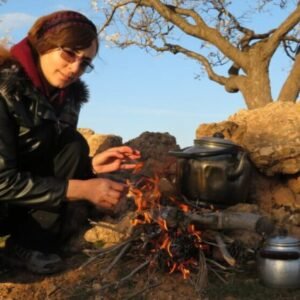
Since 2018, Ş. Zilan has lived and worked in Suleymaniye at the Jineoloji Academy and as a journalist. Her research has taken her to many places in Kurdistan, especially in Southern Kurdistan. On her travels through the region of ancient Mesopotamia, she collected personal stories from Kurdish women, stories passed down orally from generation to generation, traditional handicrafts, and books. A wealth of unnoticed creativity, undervalued and barely known, had to be brought out of obscurity to make it accessible to the Kurdish and international public.
Her idea was to make this knowledge freely accessible to all women in one place. With her ability to listen, her keen interest in the lives of Kurdish women, and her warm approachability, she over time built a network of women who supported her in implementing her idea.
Women from the arts, culture, and politics used their social connections to also create a material foundation. The dream of a center for women (public library, archive, and meeting place) became increasingly tangible.
The place was to represent the history of Kurdish women from all four parts of Kurdistan. As a city of art and literature[1], Suleymaniye was and remains the perfect place for this. Memories of important Kurdish artists and writers can be found throughout the city. However, Kurdish female artists and writers are barely visible. The city is considered a center for all four parts of Kurdistan and boasts a great literary tradition for the entire Middle East. Women from all four parts of Kurdistan live here. For many of them, the city has become a new home after fleeing war and displacement.
The founding group managed to organize material support, find suitable space, and hire staff. Narîn is one of them. She was involved from the beginning: “I come from Afrin and am a Kurd from Rojava (Western Kurdistan in Syria). I work here as a staff member at the center and the library.
Women from all four parts of Kurdistan contributed to the development of this project. All of them have different cultural backgrounds and speak a different Kurdish dialect, but we have come together here to open this women’s library together. This gives this place a special significance. Opening this center in Suleymaniye is also important because Suleymaniye has its own cultural and historical background. The city is considered a capital of literature and culture. This is precisely where we wanted to lay the first stone for the research center, the archive, and the library.”
The practical implementation could begin. The materials were organized, furniture for the rooms was selected, and presentation options were discussed. The practical work began in 2021 with the art project Xwebûn[2]. Here’s a quote from the exhibition catalog: “The goal of Xwebûn is to give female artists the opportunity to express their identity, to find themselves, and to express their true selves artistically from a female perspective.”
The space slowly filled with life. Women around the world expressed interest in this project, and the first collaborations were emerging. The official opening was planned for autumn 2022. An optimistic Ş. Zilan was brimming with ideas and, together with the staff and supporters, planned the future of the library and new projects.
“I don’t have enough time to implement all the projects I have in mind.” Şehid Zilan
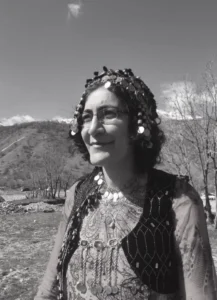
But things turned out differently. Shortly before the planned opening, on October 4, 2022, she was murdered in the street with eleven shots on behalf of the Turkish secret service MIT. She was on her way to the library. Her murderer, Ismail Rasim Rifat Peker, came from Turkey and was in prison there. He was promised a reduced sentence for the murder of Ş. Zilan. It is now known that he had been observing her for about three months before her murder.[3]
What made her the object of hatred in Turkish politics? A library employee put it this way: “She was a symbol of the power of women, a source of strength and inspiration. She was a support for many women, because conversations with her empowered many women. It was easy for her to organize women, implement plans, and thus make female power visible in society. She was truly a major threat to the patriarchy, to patriarchal society, and thus a target in the ideological war against women. A great person was murdered!”
Since Turkey has implemented and consolidated its aggressive and repressive policies not only in its own country but also in Southern Kurdistan, the number of targeted assassinations of people committed to a democratic and anti-patriarchal society has increased. Such murders are not only a threat to all those committed to a democratic and anti-patriarchal society, but they are also intended to serve as a signal. The murder of Ş. Zilan is no exception. It sends a signal to all women engaged in political and anti-patriarchal work in the region. It is intended to create fear, but the core of supporting women has not been deterred by it.
What can be done to counteract this loss?
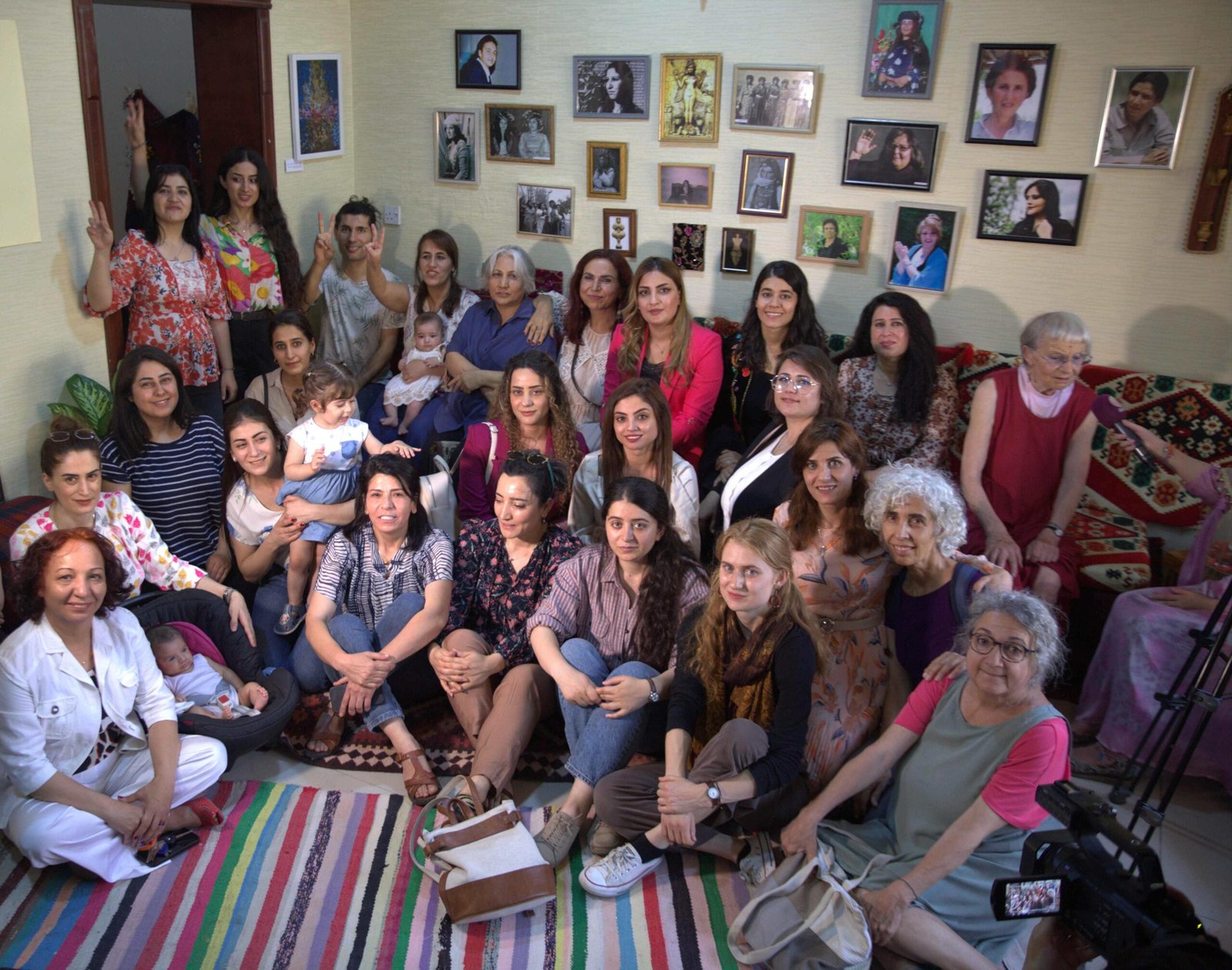
The answer is clear: Continue Ş. Zilan’s dreams and plans! For the fellow activists and supporters, a period of mourning and rediscovery began after the murder. The women now had to carry on and develop Ş. Zilan’s ideas themselves. For security reasons, a new building had to be found in a lively and safe area. The perseverance of the library team led to success: On July 24, 2023, the library was officially opened with guests from all four corners of Kurdistan and from Europe.
I had the opportunity to work at this location for several weeks. Upon entering the corner building on a busy street, the first thing that caught my eye was the library courtyard. It’s not large and, as is typical in Suleymaniye, is paved with white concrete. But there are pomegranate, orange, and olive trees here, and many flowerpots in which the seeds are sprouting. It’s a cozy place to drink tea when the Suleymaniye sun isn’t too hot.
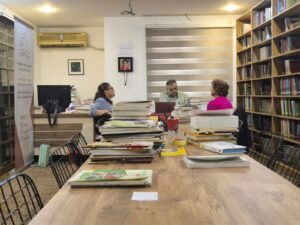
The library and archive are housed in the building, spread over two floors. Each room radiated a welcoming and open atmosphere. Downstairs in the work area, overlooking the guest sofas, I sat at my computer, and in the kitchen I enjoyed breakfast and socializing every morning. I frequently paused in front of the small picture gallery of important Kurdish artists and scholars in the meeting and event room. On the first floor, the memorial room for Ş. Zilan deeply touched me. Some of her personal belongings also serve as a reminder of all the murdered women from the women’s movement from all parts of Kurdistan.
On this floor, we also find a small children’s area and a large, functionally and comfortably furnished lending area, which is also well suited as a reading and study room. Next to it is a storage area and an exhibition room for traditional handicrafts. Throughout the building, stones are reminiscent of the landscapes of all parts of Kurdistan. Nature played a major role in Ş. Zilan’s life. Many artistic replicas of pomegranates are also a reminder of this. In the beautiful landscape of Hawraman, about a two-hour drive from Suleymaniye, there are countless pomegranate trees. Their fruits are of great importance to the region’s culture, and the women there have many stories to tell. People have repeatedly told me how much Ş. Zilan enjoyed spending time there.

4,000 books by and about women in the two main Kurdish dialects, Soranî and Kurmancî
4,000 books by and about women in the two main Kurdish dialects, Soranî and Kurmancî, and in Farsi, Turkish, and Arabic, are on the shelves. There is also a small collection of European languages and all issues of the Jineoloji magazine. The magazine has been published for ten years![4] Here, collections are systematic, and we find publications that were published in small editions and therefore received little attention. Donations enable the library to continually expand and publish its own books.
Another important task the library undertakes is event and educational work: readings followed by discussions, seminars in girls’ schools on topics such as violence against women, online bullying, and ecology. Seminars with university students on women’s identity are organized by the three permanent staff members and with volunteer support. The founding members continue to provide important support for the library, including in maintaining contact with the regional ruling party and its cultural institutions for women. Thanks in part to them, the library has official status in Iraq and Southern Kurdistan – a small protection against repression.
The work of this cultural institution, open to all women, is not easy in a society dominated by patriarchal rules. A key supporter of the library summed up the social reality: “I got married because it was the only way I could break the boundaries my family had set for me. After marriage, I was able to leave the house and pursue a career. As a young girl, I wasn’t even allowed to open the front door.”
This library is much more than a library. It is an anchor point for women where they can feel and experience their worth as women, a source of female self-confidence. Only women work here, and women are committed to socially transformative ideas. Here, women can learn about their history and present their literary and academic work to the public.
Plans and Dreams
There are plans for the library’s further development: The collection must be made available for borrowing, and it must be digitized to make it internationally accessible. A program for children to promote reading and language skills would also be desirable, and a collection of audio files with oral traditions was already Ş. Zilan’s dream. Last but not least, cooperation with women’s libraries in other countries should be strengthened.
To realize these plans and dreams, the library needs a support network beyond Southern Kurdistan. It already has dedicated, determined staff and volunteer supporters on site!
For anyone interested, here is the website: https://pirtukxaneyajinenkurdistan.com available in English, Arabic, Soranî, Kurmançî, and Turkish
[1] Since 2019, Sulaymaniyah has been designated a City of Culture and Literature.
[2] Xwebûn is the Kurdish word for being yourself.
[3] https://pirtukxaneyajinenkurdistan.com/en/post/statement-justice-for-nagihan-akarsel/
[4] 10th anniversary celebration in Amed on March 5, 2025: https://www.youtube.com/watch?v=Q97tReIIe8w