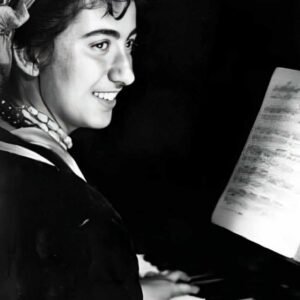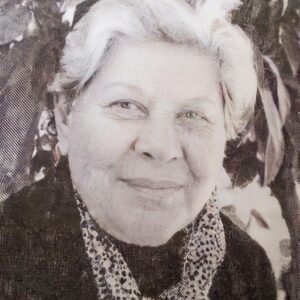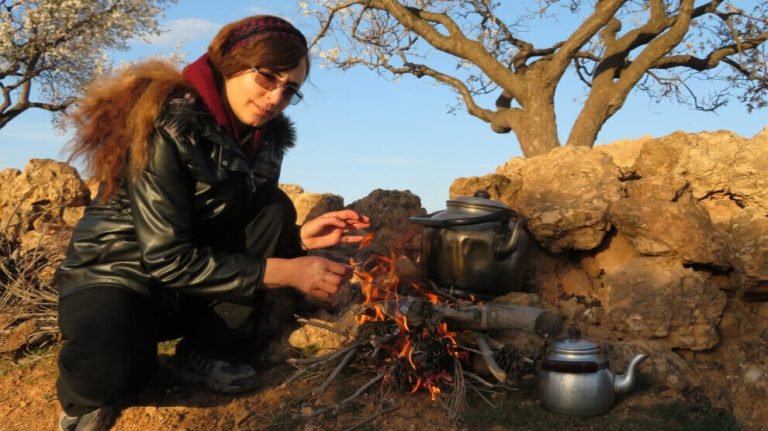
The YPJ Commander and veteran Sorxwîn Rojhilat (Mako) was murdered on 11.02.2024 in Qamişlo together with Heval Azadî. On the anniversary of her death and in light of the current situation in Rojava and Kobanê we will publish her striking memories of the Kobanê war 2014-2015.
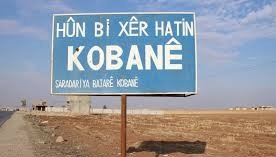
My name is Sorxwîn Rojhilat, I will tell you a little about my memories from Kobanê. The Kobanê war is something you can report on, write and talk about as much as you like, but you will never finish. Every friend who was there has their own experiences and stories. You can tell so much about each friend, about their willingness to sacrifice; it would take hours or days. But I will tell you a little about it now and keep it short.
Coming to Rojava
My crossing into Rojava and arrival in Kobanê was at the beginning of the war in Kobanê. Of course, I had already heard about Rojava and wondered what life was like in Rojava. I came when Kobanê was in a critical situation. At that time, the Turkish president spoke on television every day and said: ‘The last hour of Kobanê has come’. That’s why I made the decision that I wanted to go to Kobanê. It’s important to understand the Turkish state’s policy at the time. They say we came without notice and they didn’t know anything, but that’s not true. When we came, we were a very large group of comrades who wanted to cross the border. And there were also the Turkish soldiers and their convoy consisted of about 50-60 men. Our group and the Turkish military arrived at the barbed wired border at the same time. So we also clashed there. But we were unarmed, empty-handed so to speak. We all tried to lift the NATO barbed wire and climb through, but because it was NATO wire, it had razor-sharp blades and most of our comrades got stuck in it. A Turkish soldier said to me: ‘Go on over, you’ll be killed anyway.’
Kobane and the International Complot
When he said this, I understood that that this was not just a plot by ISIS to take Kobanê. It was a continuation of the international plot that was enforced here with the Turkish soldiers, their insults and beatings. ISIS may have started the attacks, but this is not separate from the plot against Abdullah Öcalan in 1999. It is a new form of complot, adapted to the current political situation. Until now, the conspiracy was aimed at one person, namely Rêber Apo, but now they wanted to use this form to extend the complot to an entire nation because they have not yet been able to achieve their goal. I realised that there and then. The population came to our aid at the time. They told us that everyone had run away, fled and that it was too late. Kobanê was empty, there were only four or five people left and they had also made their way to the border today and wanted to cross it and leave the city. And the people said to us, are you crazy, why do you want to go there? And they even tried to block our way so that we couldn’t cross. They didn’t want anything to happen to us or for us to be killed. The people tried to persuade us not to go, because there was nothing left of the city, Kobanê had fallen. One elderly father in particular tried to persuade me to stop. But I just said to him, do you know a better movement than the Kurdish Freedom Movement? He said no. I assured him that the movement knew exactly what it was sending us there for. Would the freedom movement send its militants there for nothing if there was nothing to try? And I told him not to stop us, to clear the way for us so that we could cross. Whether it’s lost or not is up to us, but they should let us through. I had exchanged a few words back and forth with him, but then we just crossed over.
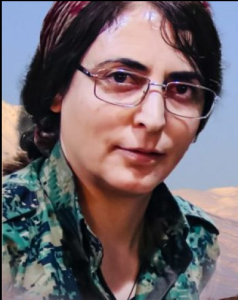
Rain of fire
It was very difficult when we crossed the NATO barbed wire and the Turkish soldiers beat us. Many of our comrades were injured on their hands, faces and legs. We crossed about 15 metres of barbed wire, the soldiers beat us with sticks, there were some wounded among us. We were stuck in the blades of the wire, our shoes, clothes or backpacks got caught in it and it was difficult to get free, the more you pulled on it, the more skin or flesh got caught in it. And there wasn’t a single stone in the area that we could have used to defend ourselves. The enemy was set upon us and there was only earth and nothing we could have used for our defence. That was of course a big mistake; I already said at the time that it wasn’t right for us to go to the other side in such a situation without self-defence. When we ran up a hill and shouted to each other: ‘defend yourselves, throw earth if you have to’. The Turkish soldiers understood us in Kurdish and they drove away in their armoured cars and retreated. We hadn’t expected the tear gas. When we ran across, I was on a path with the comrades and both sides of the path were mined, only this one path was cleared of mines so that we could cross the border there and we had to take exactly this path. Our courier had warned us about this: he said “if you go off the path to the left you will step on mines and there are also mines on the right, you have to make sure you always stay straight on the path so that you don’t step on a mine”. When we met the enemy there for the first time, they attacked heavily with tear gas and beatings. For many of our comrades – myself included – it was the first time they came into contact with tear gas grenades. I had seen such tear gas grenades on TV and had heard about them being used, but it was the first time that I came into contact with them face to face. When we attacked them back, they moved away and our comrades came to help from the other side, so we had opened the NATO barbed wire and we tried to cross the wire with the help of our shoes and backpacks.
We had reached the path, but now tear gas grenades were being thrown at us – and it wasn’t two, three, ten or twenty, no. They had thrown them at us all the way from the border, maybe fifty times, and they used different calibres. One comrade was hit in the head, he fell to the ground, they hit someone else in the arm and he had a broken hand. Everything felt like burns: your hands, your face, everywhere you touched was burning like fire. So many of us were plagued by dizziness. We ran away, but it was a plain and we had nowhere to protect ourselves. We picked up the comrades who couldn’t run and carried them with us. That is the spirit of comradeship in the mouvement; you never leave someone behind. I can say that this crossing and coming to Kobanê was much more difficult for me than the actual Kobanê war. I mean that seriously. Why do I say that? Because we were burnt all over by these gas canisters and our eyes, nose and mouth were all burning. We cried such tears that water flowed. It all came together. The worst thing was that when you shook hands with your comrades, your hands burned even more, such a strange gas was used.
Arriving in Kobanê
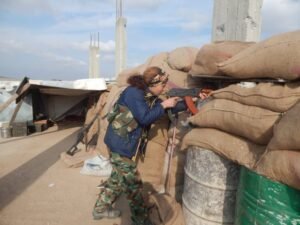
The sounds of tanks, Kalashnikovs and mortar shells were everywhere. You no longer knew whether to crawl, duck or walk upright, because it was everywhere. However, that was the situation when we came to Kobanê. It was 3 o’clock at night when we crossed over to Kobanê and because it was so dark we couldn’t recognise the comrades who picked us up. They took us by car to a place where there was war and said: “here, this is Kobanê, you’ve arrived now”. So we arrived. The YPG comrades were now approaching us on our side and they had brought a DShK, which they had placed some distance away from us so that they could shoot over our heads at the Turkish soldiers, who therefore had to retreat. This allowed us to break through and reach our comrades, who welcomed us. They then took us to Kobanê.
After crossing the border, the fact that you know that you are now on the side of Kobanê felt like a big fire had been lit insight. We call this rain of fire a rain of violence. It slowly hit the ground and burned everything. The bullets were fired from everywhere and the sky was in flames like there was lightning.
The friends picked us up in cars and took us to a certain place. The car we were in got tangled up in one of the barbed wires and three tyres burst. So we had to abandon the car and walk some distance, then we came to a car that people had abandoned when they fled to Bakûr. Our driver got into the car, short-circuited the ignition cables so the car started and we continued in this car. That’s how we arrived at our base. I’ve already described how it was getting towards dawn and we were greeted by the sounds of war. Our comrades got as far as us, they responded to the sounds of war and they had many different weapons with them. They cleared a channel so that they could reach us. Those who knew Kobanê at that time or experienced it themselves know how self-sacrificing the comrades were back then. There was only a very small unit in Kobanê; we were a very under-resourced force, but with very strong conviction. There were actually not many units, but the friends who remained there had a strong willingness to sacrifice themselves and they continued to fight well. And here we met: almost all of us were wounded somewhere from the difficult crossing with tear gas grenades, some were injured in the hands, arms, legs, head, others with broken limbs and so on. We were a force of 22 comrades. I had brought them with me from Botan. That same night we reorganised our comrades and handed over the letters we had with us to the Kobanê coordination team, the commanders in charge here were Heval Melsa and Heval Narîn Efrîn. We split in two groups, the women comrades on one side in a room that was open at the top and the men in another room. We tried to sleep with our backs against the wall until morning and get some rest.
This war is like a young horse
Then a mortar shell came flying towards the house next to us, we were half dozing when the projectile hit the neighbour building and all our windows and doors shook and splintered. Earth and stones flew through the air towards us. Our comrades took us out and we moved to a house further back. It was getting dark and we took the women comrades to other women comrades and the men comrades to the other men comrades. I didn’t see them again, because they were directly brought to the front by Heval Ferzan. There was no resting, arriving or tending to wounds. There was no question of being treated as guests: we arrived that morning and were immediately distributed to our new places. Another group arrived the same night, we were about 150 new comrades in total. So the new assignments were made. First, ever comrade got a weapon and ammunition belt and then they were distributed to the various bases.
The group I had brought here was now completely split up and I stayed behind and first went to Hevala Melsa and Hevala Narîn Efrîn. They had called me to the coordination centre at around two or three o’clock and I started by listening to the radio. They had four or five telephones and radios and these rang continuously. They passed on messages about who had come from where, where they had been attacked etc. They hadn’t gotten up from their seats since the early morning. I listened to that for a while. It consisted of the passing on of various pieces of information about martyrs, explosions, lack of ammunition or weapons, wounded people, or about where attacks and reinforcements were needed, who was to be moved where and so on. It was such a mess that when a person listened to it from the outside, their brain just switched off. I was only there for a short time. I wanted to rest for five minutes, but that was impossible here, so I went into a back room and tried to relax a little first. But that was really almost impossible with all the noise and commotion here. That was the situation. I listened to the radios passing information from midday until early the next morning to get an insight into the situation. And I can say that on that day I understood the war situation well. How is the war going, what level has it reached and what is our situation? When I listened to the radios until the early morning, I understood the movements, where the enemy is, and what our overall tactical situation is.
I understood that night and I said to myself, this war is like a young horse that is being retrained and has to learn how to move, how to carry a load, how to be ridden – and that leads to pain all the time. That was our situation, until you can finally ride the horse. And when you’ve taught it how to walk, how to carry the load and you’re riding it, then you make very easy progress. But until you’ve taught it this, it throws itself on the ground, throws you off, breaks itself or you, sometimes even its own head. A horse that has slipped out of our hands. It has slipped away from us, it is running away. Whoever tries to stop it and throw themselves on it will have their arm or leg, head or spirit broken. I said to the comrades that it is now very important that we first make a tactical decision. What tactics can we use to catch the horse that has escaped and bring it back under our control so that we can load it up and run with it?
No more guerilla clothes – Heval Gelhat
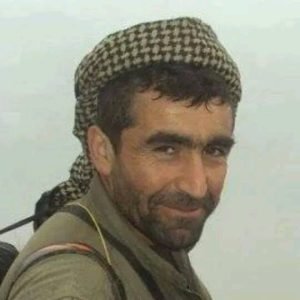
Early in the morning, I saw that a friend from another group came to me, it was Şehîd Gelhat. And Heval Gelhat came to me and said “I heard that the group from Mount Cudî has arrived”. We both knew each other from the Cudî region, we were both commanders there at the time. I was in charge of a small group and he was the regional commander. We were responsible together in Cudî for a long time, and he had come to Kobanê just a few days before us.
He came to me and said he had heard that the Cudî group had arrived and he asked me who I had brought with me. He was still standing at the door, slippers on his feet and made jokes about me, because I had come over in civilian clothes. He teased me in Turkish and said, “that’s how I see you in civilian clothes” and I just replied, “that’s how you came over back then, that’s how we came over now. That’s how the moment and the time wants us to be.” He said “the time of the guerrilla uniform is over, but now you look much younger in your new clothes. You look much smaller in the civilian clothes, where is your special attitude from the time with the guerrilla clothing?” What is it that shows up here in the war again, is the spirit of friendship: Hevaltî.
We met that very night, early in the morning, and he asked if I had brought along my young friend Heval Botan, who was also in Cudî at the time. Heval Botan was with Heval Gelhat in Cudî at the time and was maybe 15-16 years old. I then gave him all the names: Heval Mîran, Heval Xalîd, and when I mentioned the name of Heval Botan, he paused for a moment and asked me: “Why did you bring Heval Botan? How did you convince him to come?” I said Heval Mîzgîn said go with her and go back to Heval Gelhat. He asked me: “But didn’t you think anything of it, Heval Sorxwîn, that you brought him here with you?” I told him that I didn’t think much of it, because I didn’t know what the situation was like here and now we can’t change it. He took him in, he spoke of ‘kalpî’, ‘kanîya-kurdan’, ‘şêxî’ and so on, but that didn’t mean anything to me at the time. He said there is a place here that we call ‘Kaniya-Kobanê’, which means something like the source of Kobanê. And that belongs to the ‘şêxî’ region and you should tell the comrades that you would like to be sent to me in the ‘şêxî’ region. I agreed. That was the end of our conversation, he left again, but we had seen each other briefly that night.
“Don’t fall for three days” – Heval Melsa
I didn’t say anything to the comrades. ‘Şêxî’ was one of the most important and most difficult places, because the enemy was trying to enclose us there. The fiercest war was being waged there. Because we knew each other from before, knew we can both fight well in this area and lead the operation, I had agreed to go. A little time had passed, it was around 4 o’clock and Heval Meryem [Melsa Botan] had called me. She asked me: “Didn’t you come from Botan?”. I said yes. And she said: “I’m glad and the comrades wrote in your note that you were a bölük [troop] commander there so because you’ve already worked at that level we’re making you a front section commander here. You will become the front commander together with Heval Gelhat and you will lead the front section ‘Kaniya Kurdan.” I asked where that was, she told me with Heval Gelhat, on the ‘Şêxî’ side. I said: “Good, that fits.” And so we set off. A car came and brought us weapons and ammunition belts, but there were no clothes, so I continued to wear my civilian clothes and a bag with a few things. That’s how Heval Gelhat greeted me and he just said to me, “Heval Sorxwîn, defend yourself for three days. If you don’t fall martyr in these three days, then you will have learnt the tactics and the mission here and know how we have to move, how the enemy makes its attacks and so on. And once you’ve understood that, you won’t fall martyr. But you have to defend yourself well for the first three days.” Heval Melsa had told me the same thing, she also said: “You have to hold out for three days, then you’ll have learnt.”
At that point, I understood what that meant in war. You are sent as a new area front commander and really you learn to become a commander there, nobody had told me that before. And I didn’t know what ISIS was doing, how they were fighting, where they were attacking from and by what means, which side they were coming from and so on. What is the method of the enemy? What is his tactical approach? How does he attack? Then, after these three days, you will influence the outcome of the war, but you must not fall martyr in these first three days. Heval Gelhat had told me the same thing that Heval Melsa had already told me. If you know how to defend yourself for these three days, then you will get to know the area, get to know the situation and the war and you will know where the enemy is and where we are. And so you go and you will fight. Everyone just told me that: The first three days are important to understand the situation and everything, then you learn the rest by yourself. I said fine and left.
The Şêxî side
So I came to ‘Kaniya Kurdan’, the Şêxî side. It was around three o’clock. There was a small house made of mud bricks where Heval Gelhat was staying and received me. He said to me, “This is where you will learn about the war.” Heval Gelhat said: “We are now going to do some initial planning on our feet, standing still.” They showed me through a hole in the wall the place where our forces are and also a canal that was previously ours but had now been taken by the enemy. Then they showed me the different houses: who had taken which house and where, and that all the houses in front of us in a row were the front we had taken. We were only a stone’s throw away from the Turkish border. There were a few houses that lay between us and them, we would clear them today and take them back. There were a few older people from the community in the house, some fathers, they helped out where they could. Otherwise they were all young friends, a driver who kept driving to the border behind us to get things. And so we stood in front of this hole for a while and talked. It was towards evening, about 6 pm. So now I was a front section commander.
Thats just the ‘Lolo’ – Heval Çekdar
A boy called ‘Çekdar’ came to me. He was maybe 16 or 17 years old. He arrived on a motorbike, he was slim and tall and shouted “come Heval, come” with his young voice. I immediately took him into my heart. He shouted and said: “there’s a wounded friend lying on the ground, but he’s a bit fat and so I can’t lift him up on my own” He needed help from another comrade so that it would be possible to pick him up together. A sniper was still in position and firing a lot. We could hear the sound of the shots. I turned round to see who could go with him. Heval Gelhat had previously told me that the older fathers had teamed up with some civilian boys to rescue the wounded from the field of fire. I wanted to send two of them to bring the friends back with the motorbike. But when I turned around, I saw that none of them were left. It was just me and Heval Gelhat. I asked Heval Gelhat: “So where has your group gone now?” He just laughed: “They ran away. Heval Sorxwîn, this is just the ‘Lolo’, the ‘Lêlê’ is still to come1. What do you expect? There’s a sniper lying in position, who’s going to run and get the wounded? They are normal people, not fighters. Civilians do not go to the front, but they receive the wounded from us here.”
I didn’t understood. How can it be that this is the only group in here. Now this young friend came on his motorbike and asked for help, how is he supposed to get there and back? How can that be? Someone had to go with him. He also turned around and it was clear that there was no one else. He said to me: “Now you’re getting to know the war, Lêlê is still to come and you’ll experience many more situations like this.” But when you see this with your own eyes for the first time, you ask yourself where the spirit of Hevaltî is. There are so many examples in the history of the movement where comrades sacrifice themselves for their friends and ten comrades fall to save one martyr.
1 The expression ‘Lolo’ is used for the Beginning of something big, ‘Lêlê’ when it reaches its peak.
Rescuing the wounded – Heval Welat
My first approach was that I said to Heval Çekdar: “Come, I’ll come with you, take me on your motorbike, because I’m now the person in charge of the front section.” I asked Heval Gelhat for comrade Welat Zêr. He was a comrade whose whole family is with our organisation. So I asked Heval Gelhat to send him with me so we could go to the front to the wounded man. He accepted and I asked Heval Welat if he knows the area here, so he could take me there and we go and rescue the wounded man together. He said: “Yes, Heval Sorxwîn, I know this area well”. So we went. I took my weapon and Heval Çekdar zigzagged us to the wounded man on his motorbike. It was towards evening; bad conditions raising the threat of snipers. We arrived at a wall where the wounded friend was, and we left the motorbike behind the wall. I saw that he really was a heavy friend. The enemy was shouting his ‘Allah û akhbar’ and was targeting a rocket launcher directly at us. Everything around us was full of sand dust. I hid behind the wall and Heval Welat was right behind me.
I had prepared two magazines for my weapon, so when the bullet hit I fired a shower of ammunition towards the enemy. When my magazine emptied, I replaced it with the second one and heard the ISIS fighter shouting ‘Ezîr, Allah û akhbar’ at me. I emptied the second magazine, then our battle stopped for a while. When it became more quiet, I turned around and asked for Heval Welat. My attention was always focused on the crater in the ground from the rocket, but I realised that Heval Welat wasn’t there. I was so afraid that he might have been hit. My eyes went black, all I could see was that there was no wounded friend or any comrade anywhere. I had moved away from Heval Welat when I fired the hail of bullets. I left our place behind the wall where our motorbike was and found the wounded comrade. He was shot once and I put my hand on him, but we were still being shot at. I had two hand grenades with me. I unlocked one and threw it in the direction where the ‘allah û akhbar’ came from.
Then we heard shouting and various noises and the shelling stopped for a bit. I moved forward to the wounded comrade and tried to pick him up. No chance to lift him even a little. I asked him to pull himself together just a bit so I could lift him onto Heval Çekdar’s back. The enemy was right in front of us. When he heard that, he tried to help me and so I lifted him up and we placed him on the motorbike and Heval Çekdar’s back.
Heval Çekdar was very young as I said. The wounded friend was perhaps two or three times as wide as him, but Heval Çekdar fastened a scarf under his shoulders and then tied it around his stomach. So we lifted him onto the motorbike to get him out quickly. His legs still hung off when the comrade zigzagged him back at high speed. I shouted towards him, but he didn’t hear anything and drove off and brought the wounded friend to safety. Until today, this image is stuck in my head, I can’t get it out of my mind. What happened to the comrade after that, I don’t know.
In the middle of the enemy – Şehîd Mîran
I don’t know exactly what happened, but I heard noises directly behind the wall next to me. They were human voices, they could have belonged to ISIS or our comrades. I tried to assess the situation. I didn’t have much ammunition left and I didn’t know my way around here. It was already getting dark, it was evening and I didn’t know where to go. So I tried to listen to the voices, sneaked up quietly and stopped at the door of the house. I waited next to the door and realised that they were Kurdish voices. They were saying to each other ‘get up’. So I shouted ‘heval’ once very loud and a young voice came back: “Huh, heval?”. So I entered the house and saw there were nine comrades inside.
Among these nine friends were three from my group that I had brought with me from Botan. Heval Mîran, a friend from the youth group, had also been in that Botan group. He was from Bakûr and had spent six years in Turkish prison. They were the young comrades who crossed the border with me last night. Heval Cudî was also among them and he told us that Heval Mîran had climbed onto the roof of the house and had been injured there and everyone was smeared with his blood. He had not known whether Heval Mîran was still on the roof or whether he had fallen martyr. All of them had been injured.
They told me Heval Mîran had climbed onto the roof early in the morning as soon as it dawned, exactly the way he had learnt in the mountains. He wanted to get an overview of our surroundings. And so he was on the roof and had lifted his head up a bit to see, but the sniper was already in position and had shot at him. As you know, the Kobanê war was mainly a sniper war. Heval Mîran got shot directly in the head and fell martyr. The comrades around him were all new fighters. I had brought them here, but they didn’t understand the war here yet. Of course they had been trained before, but they had never been in such a difficult war situation. They were familiar with different weapon impacts: the sounds of war and warplane attacks. But this one-to-one war combat with the enemy was new. It shocked them.
We heard more voices. It was a whole ISIS group and they were coming just from outside the wall. So I sneaked to the window, peeked outside and saw them right outside our door with a red taxi. I wondered who they were. “Isn’t that ISIS?” They didn’t know. “How is it possible that you don’t know? You are in the middle of the territory of the enemy and you are not moving?” They all had been frozen in their position as if they were already dead.
“So then go to Mohammed” – Getting injured
I decided to take the grenade launcher and fire it into their group. But when I moved towards the window, they immediately realized and attacked us with heavy machine guns. They shot with two of them and broke the window. Our young comrades all threw themselves to the ground, as they learned it in the mountains, thinking that they were safe, because they were hiding behind sandbags. But besides putting their heads down, they didn’t defend themselves at all. So I went to the window to fire at the Daesh fighters. But I hadn’t taken any precautions and was hit by shrapnel flying through the air. I was knocked to the ground by a stone and blood was pouring out of my eye. I felt dizzy and went down. It was already dark. I lay on the ground and heard the friends saying: “Oh, it got her too, she also died”. They didn’t dare to move and just saw me fall to the ground. Nobody moved, but the shouts and voices from outside got louder and louder.
I tried to clean my eyes with my hand, but blood is salty when it gets into the eyes and it burned terribly. I got myself together and again went to the window where I wanted to fire a grenade. But in a confined space the pressure of the grenade launcher is multiplied. The back-tube of the weapon touched already the wall behind me, that was far too dangerous to fire. So I turned a bit to change my position and aimed the red car in front of the house.
I launched the grenade into their crowd, which made a huge noise and I was deafened for a while. So I couldn’t hear what was going on around me, but I continued shooting with everything I had…
I tried to see through a hole what was going on and saw no one around the car. But I knew they had been there, so now there had to be a lot of wounded and killed.
When ISIS fighters get wounded, they shout, scream, pray to Allah, read the Quran and call on Mohammed and demand to go to paradise. That’s their philosophy. Their voices were very, very loud and easy to hear. “So then go to Mohammed”. I got up and tried to clean my eye with my scarf. I realised that I had been hit by a stone and I bandaged my eye and then pulled up one friend after the other.
One of them I had brought from Botan; the other was a friend from Cudî. They were both hurled up in a corner. I called them to me and brought them out. Both had been here for two days, just like me, all the other had arrived six days ago. They hadn’t eaten anything, around their mouths was dry blood, the faces covered in dust.
No one is left behind – Heval Dijwar
Then I saw that Heval Dijwar had come. Heval Dijwar Koçer and I knew each other from the Botan mountains. He came in a group before us and had been here for a few days now. I told him that I had arrived only two days ago and explained the situation to him. He was part of a mobile force. They had chased and attacked the enemy just a little in front of us. Şehîd Egîd Pîr fell in this action and he had brought him in a house in front of us. “And now?” I asked him. He said “You know, I still want to get him out there.” He told me Heval Egîd had been shot in the forehead. He could not have taken him further than he did, because ISIS was right after them. He didn’t want to leave him behind. The house was in front of us. After I checked, he said he was sure that the friend had been killed. He told me, he had checked for signs of life several times, calling him again and again, but there were no answers. Still he wanted to go back tonight, when it got dark again and get him out of there.
We didn’t think he was still alive, but then we heard a whining noise. We thought it must have come from him. So Heval Dijwar said to me: “Heval Sorxwîn, will you cover me?” And he ran right away. I switched my Kalashnikov to the automatic mode and fired without any pause. ISIS did the same and all the bullets were flying around us. The distance between us was so short, everything just happened right around us. I fired at ISIS and while I was doing that, Heval Dijwar crept forwards towards the other house. He went into the yard of the house and there he stepped on a mine. It had been less than five minutes. I waited but there was no explosion. I called him: ‘Heval Dijwar’ but no answer. I tried to reach him and called again when he finally answered “Heval Sorxwîn, I saved myself”. The mine had exploded right next to him he said. I couldn’t believe it, but saw him on the ground. He didn’t move.
I called more comrades who were still in our house to help and first took care of them. I washed their faces and looked for food. I found a few tins of food in a fridge. They hadn’t eaten for days and so regained a bit of their strength. I called one of them: “Come and back me up, I’ll try to move forwards to see how Heval Dijwar is.” He didn’t know where to aim, I showed him the top window where the attacks had came from. Then I went closer to Heval Dijwar. I had prepared two magazines for my rifle. He was lying on the ground. He said the mine had exploded next to him . I lifted his legs. They seemed fine. Then I saw that he had been hit through the forehead, but it had only hit the scalp not his brain. The wound was only yellow, no blood came out and I told him how lucky he was. Probably a stone had hit his head. I lifted him up a little to clean the wound.
Face-to-face with ISIS
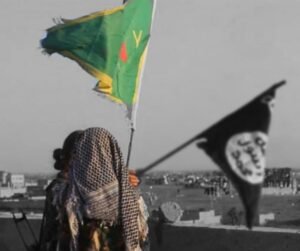
The place where Şehîd Egîd Pîr still was, was surrounded by seven ISIS fighters. We were lucky. They had set an ambush for us, but now they had entrenched themselves in the house around his body. But as we had some experience in war. Heval Dijwar had just put his head slightly through the window and had kept his arms outside. Otherwise they would have had pulled first him than me into the house by their hands. I understood how he got his wound, sneaking through the window and as soon as he had realized the ISIS fighters ran away. Otherwise he probably would have disappeared and been executed.
ISIS was afraid of women. I had made myself an ammunition belt with 12 hand grenades, because I understood that the Kobanê war was a face-to-face war. The 12 grenades were my preparation for this. I was about to stick my head through the window when I heard breathing noises from inside – like when someone is really excited and breathing fast. At first I thought it was Heval Egîd and I wanted to check right away. My weapon was still on the ground where I had put it down, but when I lifted my head, one of the ISIS fighters looked me straight in the face; we were literally face to face. He was a very long and stocky guy, with another one standing next to him and when I had him right in front of my face like that, I have to admit I got a shock. We looked directly into each other’s eyes; he also looked at me in horror, his mouth was open. I bent down to grab my gun, because he had his one ready to fire, but was also frozen for a moment. So I ducked under the window and grabbed my gun and both ISIS fighters started shooting at me through the window. They tried to aim downwards, but the shots flew over my shoulders. I ducked very quickly and only got a flesh wound. It was around 6am and I fell backwards onto the ground and because Heval Dijwar was already lying there, I felt on top of Heval Dijwar. I pulled out my hand grenade and threw one after the other into the window. I pulled out the safety rod and the ring of the first grenade and threw it through the window, then the second, the third and all of them exploded inside.
Nine chicks
The explosions stir up the dust and I heard screams from inside. I took my gun, pointed the barrel through the window and fired a whole magazine. When it was empty, I put down the weapon to change the magazine and I realised that I had been injured in my arm. It didn’t stop me; rather I felt that I was even more ready. I shot all the bullets and placed the third magazine and went on. Then I heard a voice from above on their radio telling them to shoot at us. I took the fifth hand-grenade and threw it into the room and they shot at us with a rocket launcher. The whole front yard was full of smoke. We were lying on the ground in front of the window and the rockets targeted us from above. It hit a fuel depot and everything burst into flames. There was black smoke and dirt everywhere, so I couldn’t see anything. I found my weapon and the kalashnikov of Heval Dijwar but I couldn’t see him anymore.
I had asked him to leave the scene but he couldn’t get up. Now everything was in flames: black smoke and dust and the deafening sound of the grenades. I looked for him but in vain. I couldn’t find him. I had to take his weapon and retreat out of the fire. I tried to hide behind a nearby wall, which was only a house’s width away from the comrades. From there we would have been safe. Then I spotted Heval Dijwar. He had already taken cover and only his legs were sticking out. You should have seen me in this situation. I had to stifle a laugh. How many times I had told Heval Dijwar to get up and into safe zone and he responded he couldn’t. But when the grenade launcher hit, he jumped up right away and came to the wall.
I pulled him all the way back behind the wall and asked him how he managed to get away so quickly. He just responded “Where am I?”. It wasn’t important now. I called the ambulance. Our ambulance of course was a motorbike. I had radioed Heval Gelhat to send one. The motorbike came zigzagging towards us, in such a speed that it was impossible for the sniper to aim. I pulled Heval Dijwar onto the back of Heval Çekdar. He was wounded but not so badly that he would have fallen martyr. I somehow knew that. So I stayed behind alone. I spoke to Heval Gelhat again and reached out to our group of young comrades who were rejuvenated. I also had been shot in my shoulder. You could see the bone. It wasn’t damaged but I lost a lot of blood. While I was walking my shoes filled up with blood.
One of the comrades bound the wound with his scarf. I thought to myself, if I would leave the comrades now, they would be caught by ISIS. I knew that. And they wouldn’t just shoot them, but behead them instead. That’s what I thought in this moment. Heval Diyar repeatedly told me to leave, but I couldn’t leave nine comrades behind with that risk. I radioed Heval Gelhat and said: “I am here with nine new chicks. Someone with war experience had to stay with them”. He still ordered me back and to the hospital. I replied: “Please don’t get me wrong. It’s not that I won’t listen to you, but as long as there is no one with experience, I won’t go and leave them alone.” I was wounded at 6am and stayed in position till 6.30pm.
Then, Heval Rêber Çelê suddenly arrived. He told me about all his war experience from there and there. Heval Gelhat had sent him to replace me. He was in Serê Kaniye, he said, and had a lot of experience. I accepted and described the situation, said that there is Heval Diyar and Heval Rojda and they are guarding the windows. Some would defend this direction and others those. I had made all their assignments before and had taken the body of the team commander Şehîd Mîran from the roof to where we were. I explained the whole situation and how he should treat them. After that I left. I had only just arrived in Kobanê and I already had to leave.
Relive everything again – Heval Rêber
I arrived in the hospital where they stitched my wounds. The doctor told me to stay for two days, but as soon as it was done I didn’t listen and went straight back to our place and Heval Rêber. We stayed together for five days. I hadn’t yet told Heval Gelhat that I was back. That’s not how you imagine a frontline commander to be like, but each of our commanders were in a different place in the middle of the battles. You can’t really coordinate and do much planning. After a few days, Heval Gelhat contacted me to come to see him. He said come comrades had come together and I should join too. He said: “We built a fortification when the shelling died down and the enemy had withdrawn a bit.” A large group of ISIS fighters had just arrived and we needed to do some planning.
It was needed to come together because they probably had planned to attack our front section. We needed to regain the houses in front of us before Daesh attacked us. Before I left, I had to call our forces together. It was the first time I fought with Heval Rêber in the same place. I didn’t know him from before, we had never fought together before. I only knew his name Rêber Çêlê. He was a very likeable person and captivated the friends around him. He was a warm person, you could easily build up a relationship with him. We became friends straight away.
We got the body of Heval Mîran down from the roof that evening. I went up the roof at a time of the day when the sniper couldn’t see anything. Unfortunately we couldn’t recover the body of Heval Egit Pîr. In the place where he was lying, there were also corps from the enemy. They were still there. I told everything I knew to the friends before I left to the hospital. When I came back I asked Heval Sorxwîn Kobanê for his body. I checked the car with the dead friends. I only knew Heval Mîran, the one I had brought myself, the others I didn’t know. Which one was Heval Egîd Pîr? She showed me the body of Heval Egîd. He didn’t look like a Kurd but rather Asian. His clothes were ISIS clothes. He was wearing the same dress and trousers like those worn by ISIS. Sometimes we dress so when we go to civilian tasks. He also had a headscarf like the Mahabad scarf. There was also a long thin body with eyes more typical of an Asian person. After we waited a while, I got up and said “I will go back to the house where the wounded had been” because I wanted to know whether ISIS had taken out the bodies or not. I went back into the house where the action had happened before. I saw more bodies. Eight ISIS bodies were lying against the wall and I saw Şehîd Egîd exactly as we had left him. It was really a long time that he had lying there now.
That seemed like villager mentality to me. I gathered all the friends: “You went there to recover the bodies, how can it be that you left the body of our Heval Egîd?” One of the friends stepped forward. His name was Mehmo the brother of Heval Çiya Kobanê. He boasted and said: “No, these are all ISIS corpses, you can see that from their clothes.” I told him not to make such a fuss, that some of our comrades also wear these clothes to not attract attention. “We had two wounded Hevals just because we wanted to get Heval Egîd’s body out”. Of course we had fired back sharply and I had stayed there from morning till night with my open wound, covered in blood. The friends approached this whole situation so superficially and had left the body behind. I got upset with them, told them to do their job properly and so on. They thought I was crazy.
I then took a blanket and wrapped Şehîd Egîd’s body in it. I recognised him by the Mahabad scarf around his neck. That’s why I knew exactly which of the seven other corpses must be that of Heval Pîr Egîd. We recovered him and handed him over to the Organisation of the Martyr Families. In retrospect, I can say that it was about 20 days in total that had passed since the incident until I returned to the place where it had happened and I had looked through the window one more time, where I stood face to face with the ISIS fighter. It was like I lived through everything once more. I screamed when I saw him there. The bodies were still almost intact, their faces were clearly recognisable, they hadn’t decayed yet. Besides Heval Pîr Egid, there were 7-8 more ISIS corpses. They all looked very scary, all very massive guys, with their bearded faces. They were all noticeably tall.
Anyway, so I learnt that we had killed at least 7 ISIS fighters through the ambush and our skirmish. Our comrades took the bodies away. I myself went back to the wall from which I had retreated and especially worried about Heval Welat. He was only a short distance away from the action at the time and Heval Gelhat had taken up position on another rooftop. I tried to call the friend with my radio, but I was new and didn’t know all the numbers, so I called Heval Gelhat again and asked what had happened to Heval Welat. He was all fine, he said. Those were the memories which stayed with me.
Heval Xwînda
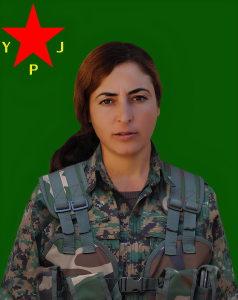
I also remember Heval Xwînda. She was from Kobanê and YPJ. She arrived after Heval Çekdar had left. It was already dark then, when she came with another wounded friend. His name was Heval Rojhat Koçer and he was from the same group I came with. His shoulder was injured and Heval Çekdar had simply dumped him at ours. Heval Xwînda wasn’t older than 18 years. She said that her friend got wounded and was brought to the hospital. Without saying anything she remained very calm and stable. On her back she carried a bag with two ammunition chains for the heavy machine gun (BKC) as well as lots of grenades and some magazines for the kalashnikov. I was very impressed. It was such a heavy bag. I couldn’t even lift it and the friend had just strapped it to her back, taken some water and returned back to her position. I asked her: “Why are you going alone when its already dark?” She just said that new comrades had arrived from the mountains and didn’t know Kobanê. So she had to go back because. “I am the only one who knows the streets and houses of Kobanê well.” And then I saw she was also wounded. She sat down to treat her leg. There was an open infected blood wound. She cleaned it, bandaged it and then brought the bodies, carried the heavy backs and food back and forth. You could feel this very special spirit of comradeship.
What does it mean to be commander – Heval Gulbihar
Then Heval Gelhat called me to come to him in the front position. First I should bring the wounded, he said, so I did and afterwards I went to his place. Reinforcements had arrived. Nine new comrades were immediately distributed to a position that had been lacking in numbers. There was a house in front of us that we had just taken over and a position was to be set up there. The comrades who had just arrived from the canton of Cizirê were from Qamişlo and we took them to that house. It was clear we didn’t know them, the headquarters had sent them. We wanted them to take a new position in a house which Heval Gelat and me cleaned ourselves. We searched for mines and hidden ISIS fighters. Each group of us had a ‘Bayraz’, which is a kind of chisel that you can use to break through the walls if you are trapped somewhere and have to make holes in the wall. When we had placed the ‘Bayraz’ in another house we heard noises from ISIS. They came from everywhere shouting ‘Allah û akhbar’ and shot bullets at us. We took the nine friends to the new place. They were all young new comrades. When we tried to find one of them to be the commander, they all replied no: “I have no experience and I will not be a commander.”
That’s what all nine comrades told us one after the other. But they were sent to us for this very reason. They were supposed to be a mobile team. What does it mean to be a commander? You have a radio and you have to liaise with the others and pass on the reports to your comrades, that’s all. But everyone said no, I don’t want to do that job. There were also two women friends among them. Heval Gelhat got angry with one comrade, he grabbed him by the collar, looked him in the eye and said, “If you don’t want to fight, then say so right away, are you an opportunist? Why did you come here and cause such a mess?” I intervened to mediate the situation. I told Heval Gelhat to relax and calm down. The comrade he accused of being an opportunist was also very upset. He was a BKC machine gun fighter and didn’t want to be portrayed like that. I called the comrades to me. One was Heval Gulbihar. She came from Sêrt and was a very small friend. She had a black streak in her hair, I remembered her by that, and I asked her: “Why are you all leaving the newly built position? We built it for you, controlled and secured it, now it’s your job to fight in it, you’re a new force from Cizirê, why did you just run away and leave the position behind?” She asked me about my name and said: “You know, Heval Sorxwîn, I’m a newcomer. I don’t really know the situation yet, and when everyone was leaving and abandoning the position, then I had to go out too, whether I wanted to or not.” I talked to her and without knowing her I handed over the radio to her and said: “You are now the commander of this newly arrived unit.”
I sent her back to her position. I didn’t know if she had any experience or not, but I gave her a phone with numbers and a radio and told her her job is to look after this group and their positions. If anything should happen, she would have my number, would call me and I would come. During this whole time, shelling and shouts from ISIS continued. I showed the positions to them, we filled sandbags behind a window to secure our positions. I told them to hold their positions well and that they must not allow ISIS to enter the house. They must always be vigilant and push them back. So I had to leave them but had declared Heval Gulbihar their commander.
Less than half an hour had passed when she called me. I asked how she was and if they had done their job. She said that they did everything like they were told and held ISIS back. I wanted her to set up a new guard and send the other one to sleep. If anything else was required she should ring me. When we hang up, I knew that this group would have no problems. As soon as a female comrade took over the command, things went well in the group.
The female comrades break the enemy – Heval Besra
In our front section every group had a woman commander. Whether it was Heval Nefel, Heval Berîtan, Heval Avaşin, Heval Zîn Sanzû or Heval Axîn, they all managed to break the enemy. It was the same everywhere on our front in ‘Kaniya Kurdan’. We always made women our commanders. For example, there was also Heval Besra. She had just left her place to tell me that she can’t command other comrades and tell them what to do. She told me that they had been attacked from both the front and the back. How was it possible that they were shot from behind? It was Heval Rubar’s group which was supposed to provide rear cover. But they had moved away and so the enemy could enter this gap and take position between them. That was why Heval Besra’s group was under fire from both sites. After this incident, Heval Gelhat came to me and said that Heval Narîn is asking for a woman commander. We should send women comrades. Really, in general we could say that women comrades did their work better. I was very pleased about that. I knew it from the mountains already. But here it was something new. When we had placed women comrades into positions of responsibility, there was a lot of suspicion that they would slow us down because of their physical differences. We were already familiar with such attitudes from before. So I was really happy about the development that for ‘Kaniya Kurdan’, Heval Gelhat told me that comrades from the other sections wanted reinforcement from our woman comrades. That was a huge strength. It was so nice to see that our deliberations and years of experience of women comrades in the mountains now showed their strength through their results. Its really a long term fight against this mentality and it takes a lot of stamina to conquer this sexist battle. But now it is bearing its fruits and we were in demand. Our group from Aleppo were mainly led by commanders like Şehîd Xemgîn, Şehîd Cudî and Şehîd Rênas. When you consider all of our teams together. it was obvious that our groups were led by women comrades.
Stubborn like a snake
With every place we fought in and every house we liberated from ISIS, we saw that Kobanê is the moment and the spirit of resistance. For example, there was a house that was four levels high and very strategically located and therefore ISIS wanted to take it. But it was in our hands. Whatever weapons ISIS had at their disposal, they dropped them all on that house. But the comrades stayed, even when ISIS had placed a big car filled with explosives in front of the house and blew it up. It remained an unsuccessful mission for them. But they tried more. We had intercepted their radio communication at that time. They said “this new group is like a snake that can’t be dealt with unless you cut off its head first before you defeat it”. So they planned to attack with four grenade launchers so we would have to run away and they could enter to take our weapons. Their plan was to drop a few mortal shells and the grenades, as well as heavy machine guns and hand grenades. Their emir, who had sent this order, also said that “these troops are so strong that when they start firing it rains down like a hail of bullets over our heads”. We further heard them say that “this group is so stubborn no matter what you are firing, grenade launchers or air missiles they don’t let go. You can only smash their heads like that of a snake”. So that was what we heard over the radio, translated by one comrade.
It showed once again how clear our comrades were. They never would have thought about abandoning their positions and running away. Their awareness was high, they would hold their position until they either won or get killed. But they would never give up voluntarily. This spirit was such a clear stance – even when ISIS sent two suicide bombers. The spirit was one of defence until the end so as to break the will of the enemy.
Everyday there were those small successes. Our front slowly moved forward. We waited for Heval Gelhat to send us an armoured dredger. There was only one in Kobanê and we all used it. Now it was still at the front section of ‘Qolbê’.
Because we listened to their radio, we knew that they planned to move all their forces towards us. They wanted to close the access between our defence line and the open corridor. Behind us we were blocked by the Turkish border. ISIS wanted to surround and cut us off so that there would no longer be an open back door to get in and out of the city. This would mean that those who were inside would have been killed one by one and no supply would be able to come through. That was their plan. We needed our own plan and wanted to move a few steps forward early in the morning, so we could reinforce our positions and extend them outwards. It was 3 in the morning and we were still waiting for the dredger to start.
Attacking ISIS…
The plan was made and we gathered our commanders. Heval Barîn Kobanê came, Heval Rêber, the taxîm commander Heval Cemil Kobanê, and Heval Dijwar. The digger was to go ahead. 25 ISIS fighters were hurled up in a house in front of us. A first group to the left and the right of the vehicle were to march forwards and clear the area up to this house. Then the third group should come.
We did so, but we doubled up. We built six groups, and used guerilla tactics. The ones in the back were to use cover to sneak upstairs and attack so we could take the whole building. We prepared ourselves. The digger came and went to the front of the house. We took fuel and petrol to the roof of the house and shot at the top of the window so they couldn’t get out. Heval Gelhat was on this roof with the petrol and fuel and we had made Molotov cocktails and threw them into the house where ISIS was. Everything was full of fuel. The sniper shot and we attacked. The house where ISIS was entrenched burst into flames. The few fighters who ran out were targeted by our sniper. So we had wiped them all out when the digger went over the first section of rubble and knocked down the house behind. Those first and second wave of attacks were very successful. The digger flattened everything down that was still standing with its lowered shovel and we were able to advance further.
For the second action we wanted one group to go alongside or behind the digger and the second would follow them. But we hadn’t realized that five ISIS fighters were hiding in the neighboring house that wasn’t destroyed yet. Because we thought it was empty we moved calmly and even gathered in front of it. But these five always had their eye on us.

…and getting attacked
When the second group was supposed to walk next to the digger, five of our nine stood up, four were still sitting on the ground in cover. They had three Kalashnikovs and one grenade launcher when they attacked us. Heval Cemil, who had also come here with us from Botan, fell Şehîd immediately, the others were wounded. Among them was Heval Rêber and Heval Barîn, who had just come out and were hit by shrapnel. So many others were seriously wounded. Heval Gelhat could move himself relatively easily when the digger was gone.
I was in the ‘şems-şemal’ group of Şehîd Feyzal around Heval Abu-Leyla, which was led by Şehîd Dîrok. I was next to our heavy machine gun commander, Heval Ebdo. I was in charge of this group and Heval Gelhat was in charge of the one with the digger, so we fought side by side. In front of us was a visible road where a pigeon flew past, the sniper had caught it and it fell to the ground just in front of our eyes. That snipers were that good. Especially the ISIS snipers – they were really really well trained. I called Heval Gelhat and told him again that his moves were far too open. Three times I had already called him to take cover. When I told him about the pigeon he just laughed. But as the war got more heavy and more and more friends died or got wounded his morale dropped. Heval Zarîn was in a position in front of us on the roof of a house and she was caught in the sniper’s crossfire after aiming at ISIS a few times. Her mistake was that she hadn’t changed her position and her hair was easily visible through the hole where she was aiming. That made her a target for them. I saw how he shot three times. One to the left, one to the right of the hole and the last one directly at her.
I saw it because suddenly there was turmoil. Hevala Zarîn was carried into a car and driven away. It was only about ten minutes later when Heval Gelhat’s group got into action. It was a very tough fight. Heval Cemal and Heval Ahmed were also there. We also sent the digger there. It got fierce. Heval Ahmed was driving the digger and got wounded in his stomach. Heval Çekdar, the young boy, was also wounded. I went to him and saw how he had been shot multiple times in a row. When I went to him, I hoped the whole time that nothing had happened to him. He was such an energetic person who infected all friends around him with his spirit. He was so angry and shouted: “What are these fundamentalists up to, they are so filthy and deviant, with their ‘Allah û Akhbar’, we will chase them out of Kobanê and wipe them out.” He shouted this again and again. I tied the scarf around his wounds. He still had several hand grenades strapped around his whole stomach for the drive with the motorbike.
Commemoration – Ş. Ehmend, Ş. Çekdar and Ş. Cemal
This picture of him, wounded in front of me, will stay in my mind. His warm youthful spirit and the lust for life: that was him. Its hurts me over and over. Of course we say every drop of blood from our martyrs is equal. But I can not forget his picture, how he had shouted so angrily at the ISIS fighters. He had already been wounded beforel a hand grenade from ISIS had hit him in the leg and when I sent him to hospital at the time, he was back after just five minutes and wanted to continue fighting. I had asked him why he had come back so quickly: “you were injured”. He said: “I had my wounds dressed – what am I supposed to do with the few splinters in my body in a hospital?”. We were in war and had to fight ISIS. So he got on his motorbike and just carried on. At one point I saw that he was crying, a tear rolled down his face. He was wounded several times in different places, but he always came straight back and now in the very last operation he did fall martyr. Really, I tell you, I was very sad abut his death. There are many of them, but Heval Çekdar really impacted me. He was literally everywhere, never stopped for even five minutes. He was always on the move.
Heval Ehmed who had driven the digger had fallen, so Heval Cemal wanted Heval Çekdar to come, to replace him, so that Heval Ehmed could be buried. They were relatives. He already had driven the digger back and turned when I said to him: “What are you doing Heval Cemal”. He said: “Heval Sorxwîn, my cousin Ehmed has fallen and my brother should come to bury him.” He also wanted me to come to the funeral to pay homage him. I stopped for a moment, but then ISIS’ voices came back. There was no time in the moment, even for something so crucial like commemoration. And we had so many wounded and injured comrades. The shouting from ISIS was so strong and if the digger would have left now, ISIS could come in the night and take our positions. We knew that they had received a lot of reinforcements. So I turned to Heval Cemal and said to him: “Look comrade, I totally understand, you’ve lost Ehmed and you want to bury him today. But please, if you drive ten minutes to bury Ehmed, 20 Ehmeds will fall martyr here in those ten minutes and that would be much worse.”
He remained silent for a moment and paused. He was also wounded, his forehead was bleeding. I cleaned him and hugged and kissed him on the spot. He really understood and decided not to leave but stay with us. So he went on with the digger but he didn’t came back any more. A sniper killed Heval Cemal through a very small hole in the digger. The six comrades who were in his group from Serhed tried to get him out. Then a grenade launcher was dropped on the machine. Heval Sînan and Heval Berxwedan went inside. Heval Ezda and Heval Rojda were able to throw themselves on the ground and were only wounded, but the friends who were in the digger and at its door were also killed. Heval Cemal was killed through the same hole as Heval Ehmed and Heval Sînan. Heval Berxwedan was hit in the eye and later also fell martyr.
Sniper war – Şehîd Gelhat
We took the wounded to the hospital. Only very few of us were left in this operation who could continue the fight. ISIS also had a lot of losses. And so there were very few of us left in this operation who could continue fighting: 24 dead in the house and another big group from the attack with the digger. So we could create an ISIS-free area around and in front of us. It was a strong operation from our side, but they had also fought back fiercely and called their reinforcements for the evening. They arrived around 5pm with more weapons.
Heval Gelhat wanted the digger back at our position. He was on the roof and took a look when he was also hit by a bullet. It targeted its shoulder right above the heart and he fell on the ground. The comrade who was with him directly turned and threw himself on him to cover. It caused turmoil; nobody was listening to anyone any more. I shouted: “Stay back, nobody moves”. I knew that the sniper was active in that moment. I really had to scream. I called Abu-Ebdo, he was an older father of several children and was in charge of carrying the wounded. He was from the village Blig. They shouted: “Bring a car”, but I screamed: “No, No, nobody is moving.” But it was too late, nobody heard me so they brought the car directly into the sniper’s vision. Yes, they wanted to rescue Heval Gelhat and bring him out. On their way to the car, the sniper shot the driver directly in the head. I saw the car pass me with two comrades – Heval Serhad and Heval Gelhat. Heval Welat was also there and I saw his hot blood running out of his mouth and nose. The car drove fast and straight into a wall. When it hit, there was black smoke everywhere. Heval Harûn was right there and took Heval Gelhat and the driver out of the car. Thanks to the smoke, the sniper couldn’t target them.
Heval Gelhat finally fell martyr in this situation. The driver was an Arab friend. The martyrdom of Heval Gelhat truly had a heavy impact on all of us. Not only him, but also the death of Heval Çekdar, and Heval Cemal; they all hit us hard. Heval Gelhat and me had been together such a long time and knew each other very well. And whether you like it or not, a loss like that naturally has a very bad effect for the morale of all the friends that remain. It brought confusion and an unwillingness to continue. But still we had to go on.
Tragedy and Comedy of war
I just shouted that we had to defend the digger and drive it in front of the wall so ISIS couldn’t reach us. Even though we had lost so much and had suffered such a heavy blow, I wanted to make sure that we who were left would defeat ISIS so they could not take the digger from us. We fought the whole night defeating all their reinforcement troops. I think we used half of the ammunition in Kobanê that night for the defence of this machine. We dropped four grenade launchers around the digger to explode the tyres. But because they were armoured the grenade launcher couldn’t destroy it. ISIS wanted to seize the digger but we truly did everything we could to prevent that. So the morning arrived, and with it a digger driver from Suruç, called Temo. He grew up in Kobanê. Command was now in my hands only. I was still holding the position where Heval Gelhat had fallen. With Temo with us we were able to reach the digger again to get our friends out of it and break through the wall. ISIS had not stopped firing at us but I could see Temo entering the digger. ISIS fired on him, but the armour was there. Watching through a little hole I saw Temo trying to communicate with me. His teeth were chattering so much I couldn’t understand anything. I tried to calm him down. But he wasn’t himself. He said he had never seen a corpse before and when he entered the door he stepped into all the blood of a friend. He hadn’t expect this. “Why didn’t you tell me there were martyrs?” He was in shock. I felt sorry I had forgotten to tell him that the driver had got shot in the head.
He tried to start the digger but something didn’t worked. Something was broken. I wanted to get him out of this almost comically tragic situation, so we decided to come back during daytime. Temo went on saying that he had never seen wounded or dead people in his life. I said: “At least point your gun at the digger so we defend it until tomorrow morning. You can hold a gun, can’t you?” He said: “Heval Sorxwîn, I would like to get my ammunition belt first, there are still magazines in it, so I can defend better across the whole night.” He had also brought some food and water in his backpack he said, so the other comrades could maintain their fight. He wanted to get it. Of course I immediately understood that he didn’t want to get anything, but sought an opportunity to run away. I said: “The comrades learned to fight without all of this, you don’t need to go.”
Those moments can be tragic and funny in the same time. Because then he said: “Okay Heval Sorxwîn, but I really have to go to the toilet.”. I said: “Go, but come back” and he answered: “Comrade, what do you think of me?”. I responded: “If you leave, how will you justify this to yourself?”. We were three women comrades left; he was the only man. If he would leave there would be only three of us again. Could he live with this knowledge? He said: “No, no, no, of course I will come back”. And so he left and didn’t come back. We spent the whole night defending this machine on our own, not only until the morning but until the next evening.
Redesigning the town
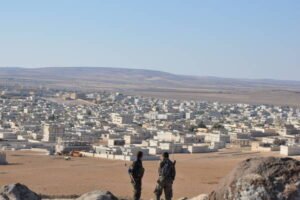
The next morning, the body of Heval Gelhat was brought to Bakûr. In the evening, a group from Aleppo came to provide us with reinforcements. It was the group of Selahadin. Much later, after the war, he would run away and depart from the movement. But in this moment, he brought Heval Xemgîn, Heval Cudî, Heval Rênas and Heval Agir with him.
He came to replace Şehîd Gelhat as the new front section commander and had brought his group with him from Aleppo. They started to build up their positions. Up to this point, we had stopped fighting: we didn’t advance any further, we just built up and improved our positions. We had perforated walls so that we could pass through them more easily in order to overcome hidden sections. We had taken tarpaulin and clothes from the stores and hung them up so that we could move behind them without being seen by snipers. This had all been done before: it was Heval Gelhat’s tactic to cover all the streets with carpets, tarpaulin and fabric. But the new positions were bases filled with sandbags. That was the tactic the group had brought with them from Aleppo. They built very stable constructions of walls, three or four layers thick with different methods. If a tank missile had hit it, it got stuck there. No matter what kind of weapon the enemy would use, they would not be able to hit you behind these walls. So we had our new sturdy “castles” as we called them. It was the beginning of a new tactic we used in every house we had taken before. We wanted to advance further.
A hundred times Heval Hacî
After everything, autonomous governance was declared. The people came back. Our positions were suddenly full of people. It was a huge reinforcement. The advantages piled up in our hands and our conditions improved a lot. The situation seemed good for us now. But how to deal with all the new friends from the civilian field, who were mostly inexperienced? A friend we called Hacî from the special forces suggested himself for self-sacrifice. When he asked me for a place to do it I refused: “No, you sacrifice yourself in every minute in every position for the comrades and the people but you don’t blow yourself up once”. And really I mean this seriously. All the people here had done this every moment, and with that they had shown what sacrifice really is. They showed their readiness, no matter what for and with which task. They fought bravely like Hacî until the end. The fallen friends from the Kobanê resistance were mainly from the society and the snipers often targeted them. Let’s remember them all, the young friends with their courageous and self-sacrificing spirit, like Heval Çekdar or Xwînda Genc. Those were the symbols of the Kobanê resistance.
This young friend from society, Hacî, was a reflection of this. He always had several grenade launchers and his ammunition belt on him, and he was always somewhere at the frontline in action. Fireworks in his pocket, the kalashnikov on his shoulder and the grenade launcher in his hand: that’s how he fought. I sent Heval Baran to him and later also Heval Nûjîn. They sneaked up to the enemy and fired. Heval Nujîn was actually at the front section next to us, but came with the mobile troops and took action. Heval Nujîn always participated everywhere and was involved in every action. She was often wounded and carried a lot of shrapnel inside her from the war. But up until the end she didn’t lose her life. She once told me: “Heval Sorxwîn, you should come too, we would be such a great team together.” But Kobanê needed some comrades with at least a bit of experience who were also older and could coordinate the operations.
Those forces who gave all of themselves in this war were truly the people of the society. They carried the spirit of Hevaltî with them and went after the enemy fearlessly. We used Hacî as their code names, because the real Heval Hacî herself was the role model of those who held up the Kobanê resistance. Once, 13 of them were trapped for 15 days. It was the group of Heval Cîmê. We were close to them but no longer in contact. We just managed to speak to each other for five minutes, because she charged the batteries with a stone for the little. From that, I knew Heval Cîmê was still alive. She said a coordinated approach was needed and the support of the air planes of the coalition. They were supposed to bomb so we could move further. Heval Mustafa interrupted. They were right in the house in front of us and if the air planes would bomb the house now, they would be buried alive. So I called the volunteer groups from society to support them instead.
We had a DShK, and dropped 10-15 grenade launchers around the house as well as other explosive devices, then I sneaked up to the comrades and entered the house. For 15 days they had been stuck, cut off from us and been surrounded by the enemy. We thought they had all fallen martyr but we managed to break through and make our way to them. I saw at once how they had defended themselves while being encircled. They literally used everything they could find against ISIS’ attacks: a fridge, carpets, they barricaded themselves with everything they could find and if there was a hole in the barricade, they stuffed it with their jackets. None of the comrades had a jacket any more.
A lot of them were injured. With them was also Heval Rûkên Amed. They had shrapnel everywhere, but in the places that the shrapnel had entered their bodies the blood had dried up. One friend was completely black from dirt. That was the state they were in. Heval Cîmê had splinters in her head, and her her hair had been partially torn off. Initially, they shot at us when we came because they thought we were ISIS, but then recognized our voices. It was me and Heval Medenî who came. Ten of them hugged us at once. It felt like being born a second time. Some cried. We had brought water, food and ammunition. Some of them we send to other areas. Heval Cîmê refused, she definitely wanted to stay with her group.
Psychological warfare
We cleaned the houses in front of them, which had been occupied by ISIS, to allow them to take a breath. From then on, we moved forward day by day and pushed ISIS back further.
They had this philosophy that if they were killed during their meals they will go to paradise. And we knew when the time for food had come, hence prepared ourselves for this. Slowly, slowly, we became familiar with their tactics and could force ours onto their backs. We sneaked onto them unnoticed when they were using special warfare methods. For example they recorded their Allah û Akhbar shouts and when one of us came they would play this tape to scare us. We found this tape when we captured one of them. Another example: they set up two chairs in front of our position and put two cut-off heads there early in the morning. We don’t know if they were the heads of their own forces or civilians, but for sure they were not of our comrades. It had happened before, that they beheaded our friends and presented them to us, but during that time none of us was captured. By that point we were not losing friends to martyrdom any more. But still. there were always new cut-off heads.
Friends exposed this psychological warfare and took action against it. That’s why I repeatedly say that the spirit of resistance was the comrades who became immortal in Kobanê. I will always think about them like this.
So time passed and we progressed in the war. More and more people came back to Kobanê and we were able to build up three lines of defence. We advanced further and further.
Talking for days – Heval Nefel
I would love to talk about all our martyrs one by one, but that would need days. But one was Heval Nefel. She came from Botan. She was really new in the movement, maybe six months and came directly from her first military education to Kobanê. She was trained on the BKC. Wherever she set up her position she stayed, showing no sign of fear and would never have surrendered. She called her BKC “Deer” and I only had to say her name for her to instinctively know what was needed. She just said: “Tell me where I should set up my position?” Then she took her “deer” and got into position.
Believe it or not, if the situation became tricky, Heval Nefel was there. Normally you can’t put so much responsibility on such a new friend. But Nefel was born in war and always knew what to do. She exuded such a strong bond and love for her country. We had so many of those great people, like her or Heval Berîtan, Heval Zîn Sanzu, like Mazlûm Genc, like Heval Cudî or Baba Mislîm. There are so many historical stories lying inside Kobanê. Like Heval Hebûn or Şehîd Özgür; they were the spirit of the time of the revolution in Kobanê. Each of them has a heroic story and their own story, we could write an endless book about all these heroes and we still wouldn’t tell all the stories.
Miştenur
We made such good progress that we reached the “Miştenûr Hill”. One day, I had a fight with Selahedin. He wanted to separate the women comrades from the others and forbid them to be the commanders of the mixed units. So we withdrew all the women comrades we had as commanders in Kaniya Kurdan and set up autonomous women units. When I was asked why I was doing this, I just said, “Don’t ask me, you have to ask Selahedin.”
We were at war; everyone had a different psychology and circumstances of life. Some started relationships during the war because they thought they would anyway die and never would see the liberation of Kobanê. If you are not in a stable mindset during a war and lose the control over your feelings, you try to compensate and fill up the holes. It happens, especially if its a long war.
We were now two bigger groups. One of them was led by Heval Masîro and was positioned behind the Miştenur mountain to spy. According to their information, we could access the mountain and set up two new tabûrs. To this point, the whole site of Kaniya Kurdan was liberated so we wanted to move along quickly. Only Miştenur was left. If we would manage, we could officially declare the liberation of Kobanê. Everyone was prepared, we already took our flags with us. In the ISIS radio we heard them saying “They are bringing red meat”. We knew the meaning of that. Red meat was their code for the hard fighters, “chicken meat” the one for the new fighter. We finally understood their codes. They had talked so much about meat the whole day. I once had the coordination shift, walking back and forwards between the comrades. Often ISIS attacked around 5am when the comrades were sleeping, so I got my report for the day from Heval Helda that early. She was a sniper. She fell martyr but until the very end she carried the spirit of self-sacrifice. She was really a hero. Heval Devriş was also there as a sniper. He had performed great heroic deeds during the Kobanê resistance, but unfortunately afterwards he betrayed the movement and went away. The war had broken him and he couldn’t fill the void. It was the snipers who prevented ISIS from building their positions; not in the morning, the evening or whenever. They always had their eyes on the city. When the war was over, we had a lot of good snipers.
The tanks are coming
Sometimes, friends who newly arrived were first sent to education for around three months. So they only joined us at the end of the war. This really allowed us to make great progress every day. We knew from the ISIS radio that they planned a major attack. We also had received the information that 18 ISIS cars from Bakûr were on their way to the town. I got the report around 5am in the morning and laid back down because the attack was supposed to start at 6pm. But as soon as I laid down a friend said: “Heval Sorxwîn, that’s the sound of tanks.” We knew that only tanks could break through, because our positions were now very stable and secure. They would probably try to blow up themselves with an armoured vehicle. So I got up straight away, grabbed my belt and my weapon and went out. Heval Deştî was in charge of the ammunition supply. Because he had already been badly wounded for the second time, I gave him this task.
There was also Abu-Şoreş. He was the father of 12 children and one of his children was also a guerrilla in the mountains. He was responsible for our logistics. I went up to the rooftop of a two-levelled house and spoke to the comrades on the radio. It was an autonomous team; only women friends. I told Hevala Cimê to get all her forces into position. The tanks were coming but no one should panic. They should take their precautions and protect themselves. So I informed all our forces and warned them that it is going to be a day of fierce war. I hadn’t even finished when fire broke out everywhere. It was the start of their attack. ISIS had set fires everywhere, they were burning cars and tires. The smoke was so thick you couldn’t see anything. There was a lot of bullets. A car exploded and with it dozen of other explosions started. The tanks came. One straight towards us. In three or four places were suicide bombers. They drove their cars in front of our positions and blew themselves up. They really had brought together a huge force which was willing to sacrifice itself.
Of course, I also went directly to our comrades to strengthen them and asked Heval Deştî to quickly bring in new supplies wherever the comrades’ ammunition was running low. I had also told the logistics officer to plan a good food supply so that the comrades didn’t run out of food, because it looked like it would be a long operation. Only the women’s group was in position. I really didn’t want them to fall martyr. There were bullets flying over me again and again, something exploded right next to us. It was a very hot phase of war. Dark clouds of smoke everywhere. I actually wanted to go straight to Heval Cimê, but I couldn’t see anything. A projectile flew directly over us, like a ball of fire it came towards us. Everything around me was burning and I fell on the ground. I was lying on my back. Opposite our position was Heval Hamza and I saw him run straight towards me when he saw me fall. He carried me and others out. Then I just remember feeling something soft, but I was blindfolded and I just felt myself being moved and taken from one place to another.
The heart wants to live
I saw nothing. Someone next to us cried terribly and sobbed the whole time. I asked: “Who is that?” It was Heval Hamza, and I said to him: “Come open my eyes, what’s happened?” He just cried and said to himself: “Oh weylo, I wish my eyes had been hit instead of yours”. Slowly I understood that something bad had happened to my eyes. I fainted and didn’t realize that my comrades were taking me from Kobanê to Bakûr in an ambulance. When they loaded me from a bar into a Turkish ambulance at the Turkish border and pulled me along, I regained consciousness. I could hear Heval Arîn’s voice saying: “Our Sorxwîn, our Sorxwîn”. My clothes had been cut in the ambulance and I was given a patient’s dress. The voice “It’s our Sorxwîn” stayed in my ear the whole time, then I stopped noticing anything else. A long time passed. I opened my eyes some days later in a hospital in Bakûr. My injury was not insignificant: my eyes were completely gone and I had a lot of pieces of shrapnel in my head.
Everything from my ear had slipped upwards and I was completely burned from top to bottom on one side. My skin was black. It looked as though someone had poured burning liquid over me and set it on fire. My right hand was wounded, because I had also taken a bullet there. I had my old injury on my left side. My legs were also full of shrapnel and I had 30 pieces in my upper stomach. There were three very large pieces that injured me in my stomach, one piece as big as my hand went into my abdominal cavity and injured my intestines. Both legs, both arms, the old wound on the left and a few new injuries. The right hand was badly injured, my stomach and head too. I felt like a person patched up in small pieces. There were four other wounded comrades. When the doctor brought me to them, he realized that I was awake and said: “When you were brought to us among the three wounded, we thought there was nothing left of you that wasn’t injured. We said to ourselves: “she is a women, how is she supposed to live with that appearance. Even if we treat her, how shall she continue her life?” So they decided to let me die, because I was bleeding so much you could see right through the bone and they decided to save the others first.
However another doctor at least stopped my leg from bleeding. He told me: “It really looked like all your blood was gone and only yellow fluid left. But your heart kept beating so strong; it didn’t want to stop. It wanted to live so much and just kept going.” Doctor Osman had seen all of this: “This women doesn’t want to die, let’s get her fixed up”. And so they started to treat me, and after half an hour my situation stabilized a little bit. They had to give me blood. I don’t remember exactly what blood group I have, A or B negative. In any case, a blood group that can’t be found so quickly. They tried for 10-15 minutes to get blood for my blood type. Eventually they requested blood from the state. They treated me and the doctor said to me: “You’re like a little miracle, you were about to die but you didn’t go.” He was shocked when he saw me a long time later, still alive. He was so happy, came to me, took my hand and kissed me on the forehead because he was so overwhelmed. I was sitting in a wheelchair next to the window.
Exactly two months later, I was sitting there looking through the window, when the doctor who did the check-up saw me again. He saw that after such a long time I was on my feet and he asked my name. He could remember me coming straight to him from the war. That I survived made him scream. A whole group of nurses was around him and together we covered the entire corridor. The doctor told the nurses that I had come straight from the war in Kobanê and that I didn’t speak Turkish. So that was my situation when I was wounded and had been in hospital in Bakûr for two months but was still alive. Kobanê was liberated just a few days after I was wounded.
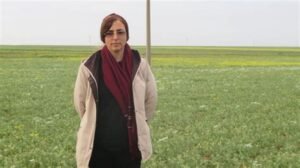
Liberation and never forgetting
I was lying backwards in the hospital bed and there were three Kurdish channels on the television. I had switched to Çira TV and so I was able to follow all the news from Kobanê. Heval Dilbirîn who got wounded next to me came with me here, but he died. I saw the death of Heval Viyan Peyman in the news. I followed everything what happened in the town in the last days via the Çira channel.
Then the day came when we announced the liberation of the Kobanê. This day… I don’t even know how to describe it now. The great joy and excitement that this day really had coming was and remains indescribable. On the one hand, my heart exploded with joy, on the other hand my eyes were full of tears that wouldn’t stop flowing. One eye was completely wounded and consisted only of a deep wound. At the same time, my heart was beating so strongly. It was on the one hand the love of liberation and on the other hand all the comrades who had fallen in the battle. The people who had fled and came back to rebuild the ruins. The great joy and the great pain for the loss of the comrades. I cried terribly. Because of the wound there were no tears only blood.
A nurse came in who hadn’t seen me before. I didn’t even noticed here. She immediately called all the doctors together, but there was no eye specialist. She saw the TV videos of the Kobanê liberation. How the comrades were hoisting the seven-metre-long flag. How the people were gathering together all over the hill of Miştenûr. The doctor looked at me, then at the TV and then back at me until he switched off the TV and gave me a relaxing injection. I fell asleep for quite a while and only opened my eyes again after a long sleep. When I woke up again, I immediately said: “Switch the TV back on”. I had calmed down a bit. It’s not easy for a person to express such feelings. What I had been through is not something that can really be told. And I think what I was going through at that moment was something I had never experienced before in my whole life.
That’s how it was. After that, I came back to Kobanê. I would like to tell you a bit more about Şehîd Deştî, Şehîd Azê, Şehîd Serbest, Şehîd Xemgîn, Şehîd Nûda, Şehîd Nefel, Şehîd Zîn Sanzu, Şehid Hamze, Şehîd Berîtan, and Şehîd Feyzal (Abû Leyla), with whom I was together for a long time, Şehîd Ebdu and all the others. I would like to tell you a bit more about all of them afterwards.
Because all these comrades were such dear friends. Şehid Hebûn Derîk and Şehîd Özgür, with whom I was meeting, Heval Çekdar… and there are really thousands of them, the comrades from the society who fought with us, we can tell you much more about all of them individually and remember them. But this is what I can tell you for now.
1 The expression ‘Lolo’ is used for the Beginning of something big, ‘Lêlê’ when it reaches its peak.